Recovery looks different than expected, a new complication appeared, or a diagnosis arrived months too late. Now you face painful questions about whether a healthcare provider's error caused preventable harm. A Connecticut medical malpractice attorney reviews whether the care you received fell below accepted medical standards and caused your injury.
At The Flood Law Firm, we evaluate complex medical negligence claims for patients and families throughout Connecticut. Our team reviews medical records, consults with qualified professionals, and identifies where providers failed.
These claims involve strict procedural rules that make early legal guidance critical. Contact The Flood Law Firm for a free consultation to discuss what happened and explore your options.
Why Choose The Flood Law Firm as Your Medical Negligence Attorney in CT?
Medical malpractice litigation demands more preparation than most personal injury cases. These claims require extensive medical records, testimony from qualified professionals, and familiarity with Connecticut's strict filing procedures.
Our attorneys have spent years handling serious injury litigation in Connecticut courts, including claims involving surgical errors, delayed diagnoses, and birth injuries. The Flood Law Firm reviews medical negligence cases that other firms turn away. Many of our clients come to us after another attorney declined their claim or questioned its value.
We also accept referrals from attorneys in criminal defense and other practice areas whose clients face complex malpractice situations. That referral network reflects the trust other Connecticut lawyers place in our ability to handle demanding cases.
From offices in Middletown, Danbury, Waterbury, and Bridgeport, we represent clients across Connecticut's judicial districts. Every consultation is free, and we take medical malpractice cases on a contingency fee basis. That means no upfront legal costs. Call our Middletown office at (860) 346-2695 to start your case review.
What Does a Connecticut Medical Malpractice Attorney Need to Prove?
Connecticut medical malpractice claims require proof of four legal elements. Each element must be supported by medical evidence and testimony from a qualified professional. Failing to establish even one may result in a dismissed claim.
Every element serves a different role in connecting a provider's conduct to the patient's injury.
| Element | What It Means |
| Duty of Care | The healthcare provider owed you a professional standard of treatment. |
| Breach | The provider departed from what other qualified professionals in the same field consider acceptable practice. |
| Causation | The provider's error directly caused your injury or worsened your condition. |
| Damages | The injury resulted in measurable losses like medical bills, lost income, or pain. |
Building a claim means connecting all four elements with evidence. That process starts with a thorough review of what happened and why.
How Does Standard of Care Apply to Your Situation?
Standard of care is the level of treatment a reasonably competent provider in the same medical field would deliver under similar circumstances. The benchmark comes from what other qualified professionals in the same specialty do when facing the same clinical situation.
A Connecticut medical malpractice attorney works with medical professionals to evaluate whether the care you received fell below that benchmark. The assessment examines the provider's specific actions and decisions rather than focusing only on the final outcome.
What Role Does Causation Play in a Medical Malpractice Claim?
Causation means the provider's mistake directly caused your injury. This is often the most contested element in a malpractice case. Defense teams frequently argue that the patient's underlying condition caused the harm, not the provider's actions.
A surgical instrument left inside a patient presents relatively clear causation. A delayed cancer diagnosis raises more complex questions, because proving that the delay changed the outcome requires detailed expert analysis.
What Medical Errors Lead to Malpractice Claims in Connecticut?
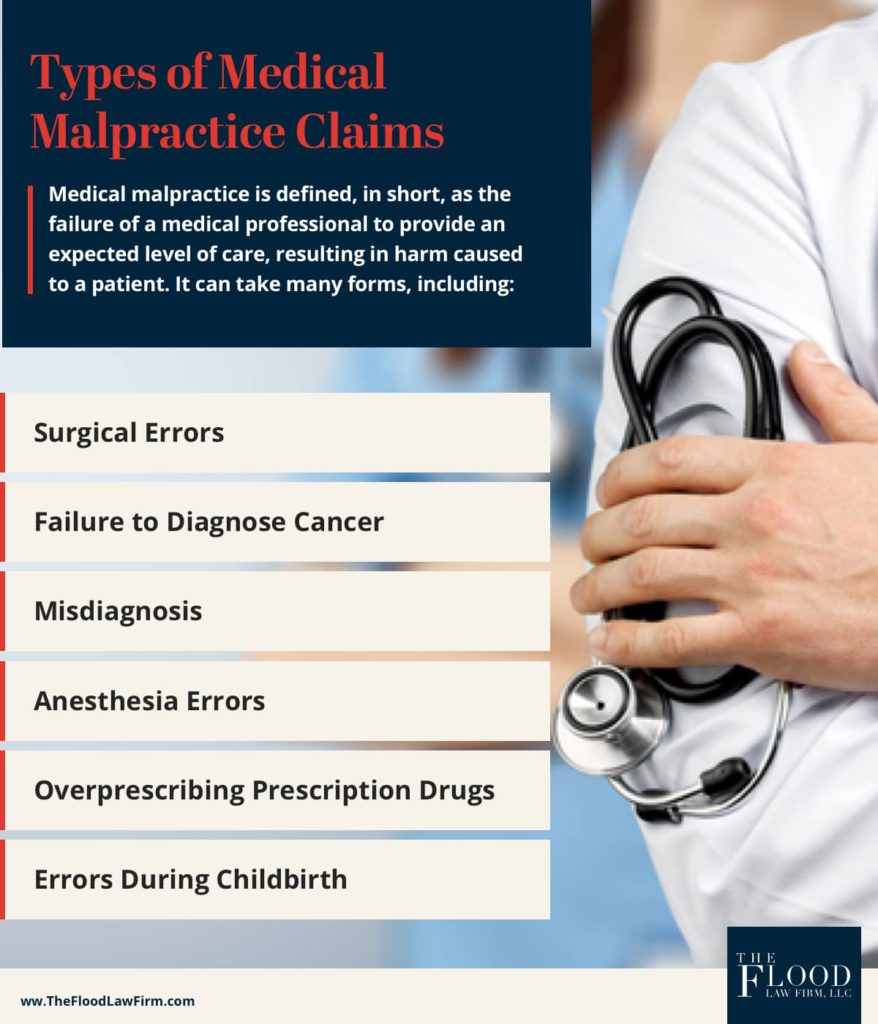
Medical malpractice takes many forms depending on the type of treatment and the healthcare setting. Some errors happen during surgery. Others involve missed diagnoses or dangerous medication combinations.
Connecticut patients file malpractice claims involving a range of facilities, from major hospital systems to private practices. The type of error often shapes the complexity of the claim and the expert review needed to support it.
Surgical Errors and Hospital Negligence
Surgical mistakes include operating on the wrong body part, leaving instruments inside a patient, or damaging surrounding tissue during a procedure. Hospital negligence may also involve inadequate staffing, poor sterilization, or failure to monitor patients after surgery.
These errors occur at facilities across Connecticut, including major health systems like Yale New Haven Health, Hartford Hospital, and UConn Health. Surgical errors frequently lead to additional operations, extended recovery, or permanent impairment.
Misdiagnosis and Delayed Diagnosis
A misdiagnosis occurs when a provider identifies the wrong condition. A delayed diagnosis means the correct condition is identified too late to prevent further harm. Both errors may allow a treatable illness to progress unchecked.
Cancer misdiagnosis is among the most common examples. When a provider fails to order appropriate testing or misreads results, months of treatment opportunity may pass. Delayed diagnosis claims require expert testimony showing that earlier detection likely would have changed the medical outcome.
Medication Errors and Anesthesia Mistakes
Medication errors include prescribing the wrong drug, the wrong dosage, or a drug that conflicts with another prescription. Anesthesia mistakes may involve administering too much or too little sedation, failing to review a patient's history, or not monitoring vital signs during a procedure.
Both types of errors carry serious risks. Brain injuries caused by surgical errors or anesthesia mistakes may result in permanent cognitive impairment or disability.
Birth Injuries Caused by Provider Negligence
Birth injuries linked to medical negligence may involve improper use of forceps or vacuum extractors, failure to perform a timely cesarean section, or inadequate fetal monitoring during labor. These errors may lead to conditions like cerebral palsy, brachial plexus injuries, or oxygen deprivation.
Families in these situations often face lifelong caregiving needs and significant medical expenses. A medical mistake lawyer in Connecticut evaluates whether the delivery team's actions fell below the expected standard of care.
How Does Connecticut Law Affect Your Medical Malpractice Case?

Connecticut law affects medical malpractice cases by imposing unique filing deadlines, expert review requirements, and procedural rules that do not apply to most other injury claims. These requirements shape every stage of a claim from initial filing through resolution. Missing a single procedural step may end a case before a court reviews the medical evidence.
What Is the Expert Opinion Letter Requirement?
Connecticut law requires a written opinion from a qualified medical professional before a malpractice lawsuit may proceed. Under Connecticut General Statutes § 52-190a, the plaintiff must attach a good faith certificate and a detailed opinion letter to the complaint at the time of filing.
This opinion letter must come from a provider in the same or a similar specialty. It must state that the care fell below accepted standards and that the deviation caused the patient's injury. Without this letter, the court may dismiss the case entirely.
How Long Do You Have to File a Medical Malpractice Claim in Connecticut?
Under Connecticut General Statutes § 52-584, most medical malpractice claims must be filed within two years of when the patient discovers the injury. The clock also starts when the patient reasonably might have noticed the harm.
Connecticut also imposes a three-year statute of repose. No claim may be filed more than three years after the act or omission that caused the injury, with limited exceptions. Once these deadlines pass, Connecticut courts lose authority to hear the claim. Reach out to discuss your timeline during a free consultation with our team.
How Does Medical Negligence Lead to Catastrophic Harm?

Medical errors may cause injuries far beyond what the original treatment aimed to address. A preventable surgical mistake, a missed diagnosis, or an anesthesia error may leave a patient with permanent disabilities that alter daily life. Medical errors remain a leading cause of preventable harm in American healthcare settings.
Catastrophic injuries from medical negligence often carry long-term medical, financial, and personal consequences. The following types of harm arise frequently in Connecticut malpractice claims:
- Oxygen deprivation during surgery or anesthesia errors may cause traumatic brain injuries that result in permanent cognitive and physical impairment.
- Surgical mistakes involving the spinal cord may lead to partial or complete paralysis that requires lifelong medical support.
- Medication errors or missed infections may cause organ damage that demands ongoing treatment or transplant procedures.
- Delayed diagnosis of vascular conditions may result in loss of limb function that permanently limits a patient's mobility and independence.
- Medical errors may give rise to wrongful death claims when medical negligence leads to a patient's death, leaving families to pursue legal action on behalf of their loved one.
A thorough case review helps determine whether the provider's error caused the harm and what compensation may be available.
Do You Need a Connecticut Medical Malpractice Lawyer?
Medical malpractice cases in Connecticut require more than a strong belief that something went wrong. They demand medical evidence, expert testimony, and compliance with strict procedural rules. Pursuing a claim without legal support often puts patients at a serious disadvantage.
Several factors make working with a Connecticut medical malpractice lawyer critical in this area of litigation. These issues arise frequently and often require an attorney's involvement to resolve:
- Hospitals and healthcare providers retain well-funded defense teams that challenge every element of a claim.
- Connecticut's expert opinion letter requirement under § 52-190a demands a qualified medical professional's written assessment before a lawsuit may proceed.
- Medical records contain complex terminology and documentation that requires professional interpretation to identify evidence of negligence.
- Proving causation involves competing expert opinions about whether the provider's actions or the patient's underlying condition caused the injury.
- Strict filing deadlines under Connecticut law mean that delays in seeking legal guidance may permanently eliminate the right to file a claim.
Even seemingly straightforward cases often involve layers of medical and legal complexity. A Connecticut medical malpractice lawyer reviews the full picture before advising whether a viable claim exists. To discuss whether your situation supports a claim, call (860) 346-2695 for a free evaluation.
What Happens After You Contact The Flood Law Firm?

Our process begins with a free consultation. During this conversation, we review the facts of your situation and discuss whether your experience raises potential malpractice concerns. This initial review carries no cost and no obligation.
After the consultation, our case evaluation follows a clear path. Each step below reflects how we move a potential medical malpractice claim forward:
- We request and collect all relevant medical records, including hospital charts, physician notes, and test results.
- Our team works with qualified medical professionals to assess whether the care you received fell below accepted standards.
- If the evidence supports a claim, we prepare the required good faith certificate and expert opinion letter under Connecticut law.
- We file the claim in the appropriate Connecticut Superior Court and pursue fair compensation on your behalf.
- Throughout the process, we keep you informed about case developments and next steps at every stage.
Each case moves at its own pace depending on the complexity of the medical issues involved. Request your free case review online or call our Middletown office at (860) 346-2695 to begin.
How Are Medical Malpractice Lawsuits Filed in Connecticut?
Medical malpractice litigation in Connecticut moves through the state's Superior Court system. Claims are typically filed in the judicial district where the medical treatment occurred. Patients treated at Hartford Hospital often file in the Hartford Judicial District. Those treated at Yale New Haven Hospital may file in the New Haven Judicial District.
The National Practitioner Data Bank tracks medical malpractice payment reports across every state. Connecticut's data reflects active malpractice litigation involving hospitals, surgical centers, private practices, and emergency departments. Patients from Middlesex County to Fairfield County file claims against providers at facilities of every size.
Connecticut's healthcare landscape includes large academic medical centers like Yale New Haven Health and UConn Health alongside smaller community hospitals. Regardless of where treatment occurred, the same legal standards apply.
Our offices in Middletown, Danbury, Waterbury, and Bridgeport allow us to serve clients statewide while maintaining proximity to the courts where these cases are heard.
FAQs for Connecticut Medical Malpractice Claims
How expensive is a medical malpractice lawsuit in Connecticut?
Most Connecticut medical malpractice firms, including The Flood Law Firm, handle these cases on a contingency fee basis. The client pays no attorney fees upfront. Legal costs come from the recovery if the case succeeds. If there is no recovery, the client owes no attorney fees.
Why do many medical malpractice cases get rejected?
Many cases are rejected because the medical evidence does not support a breach of the standard of care. Malpractice claims require a qualified medical professional to confirm that negligence occurred and directly caused harm. Without that confirmation, most firms decline the case. The Flood Law Firm reviews cases that other attorneys have turned away.
Does a bad medical outcome automatically mean malpractice occurred?
No. A bad outcome alone does not establish malpractice. Medicine carries inherent risks, and complications sometimes occur even when providers follow proper protocols. Malpractice requires proof that the provider's care fell below accepted standards and that the deviation directly caused the patient's injury.
What records are important to keep after a suspected medical mistake?
Copies of all medical records, discharge summaries, test results, and billing statements help build a stronger case. Notes about symptoms, changes in condition, and communications with providers also add useful context. These records often play a key role in proving that your doctor deviated from the standard of care.
Is it possible for more than one healthcare provider to be responsible?
Yes. Multiple providers may share responsibility in a single malpractice claim. A surgeon, anesthesiologist, nurse, and hospital may all face liability if their individual errors contributed to the patient's injury. Connecticut law allows claims against each responsible party.
Take the First Step Toward Answers

Sorting through what went wrong during medical treatment is overwhelming, especially while you’re managing pain or supporting a loved one through recovery. The Flood Law Firm offers free consultations to help Connecticut patients and families understand whether they have a viable claim.
Call our Middletown office at (860) 346-2695 or contact us online to discuss your situation. There are no upfront costs to get started.