Truck accidents are different from those involving ordinary passenger cars. According to the Insurance Institute for Highway Safety (IIHS), 3,660 people lost their lives in tractor trailer accidents in 2014. 68% of those victims were the occupants of passenger cars.
A crash involving a large truck is responsible for a death every 16 minutes in the U.S.
When comparing the difference in size and weight of the two vehicles, it’s obvious you’re more likely to suffer severe, life-altering injuries in an accident with a tractor-trailer. Both immediate and long-term medical care costs are bound to be more than the average family can afford.
If you or a loved one has been injured in an accident involving a tractor-trailer or semi-truck, you should speak with our Connecticut truck accident lawyers who handle these types of cases. Not only will your attorney understand the hardships your family now faces, they understand the laws that apply to truck drivers and have the resources to conduct a thorough investigation.
Call today for free consultation (877)-987-9LAW
- What Does a Truck Accident Lawyer Do?
- Are There Special Laws for Truck Drivers?
- Dangers of Truck Accidents
- What Percentage of Accidents Are Caused by Tractor-Trailers?
- What Are the Most Common Injuries in Truck Accident Claims?
- Compensation for Truck Accident Injuries
- What Questions Should I Ask a Lawyer About a Truck Accident?
- Get a Truck Accident Attorney
What Does a Truck Accident Lawyer Do?

There are two steps you should take after being in a truck accident. First, you should seek medical attention. If you are not taken to the hospital directly from the scene of the crash, go to the emergency room on your own as soon as possible.
Second, you should meet with a lawyer promptly.
Until you speak to an attorney, nobody is looking out for your best interest. The truck driver, the trucking company, and their insurance carriers are concerned with protecting the bottom line and limiting liability, not preserving your rights or compensating you fairly.
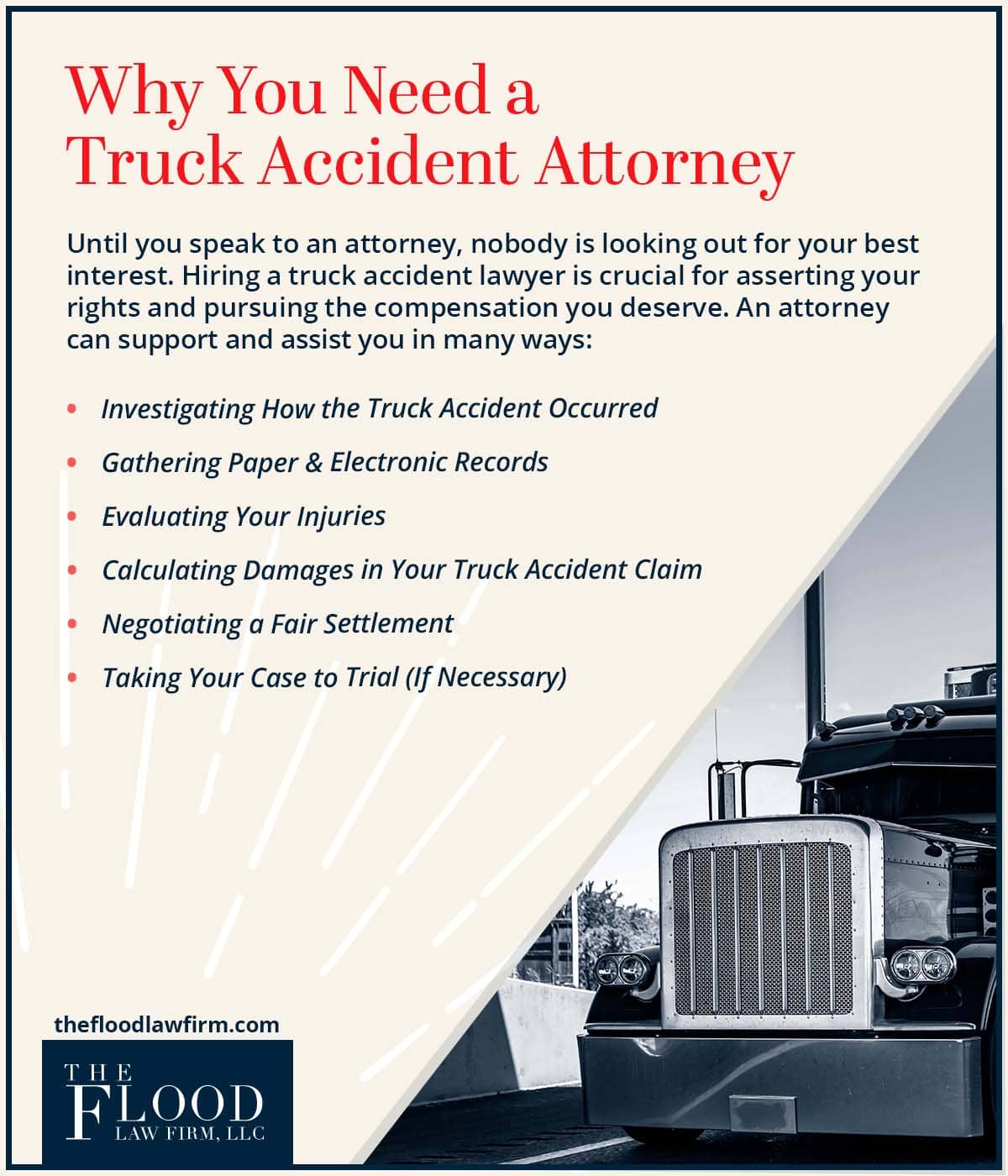
Hiring a truck accident lawyer is crucial for asserting your rights and pursuing the compensation you deserve. An attorney can support and assist you in many ways after an 18-wheeler crash, including:
- Investigating how the truck accident occurred. Although they happen in the blink of an eye, crashes are a series of events that need to be unraveled in order to determine who is at fault. Your truck accident lawyer can hire investigators to collect evidence at the scene and enlist experts to reconstruct what led to the collision.
- Gathering paper and electronic records. One of the ways truck accident claims differ from other types of vehicle collision cases is the amount of paperwork involved. A truck accident lawyer can request copies of the records maintained by the driver and the trucking company, as well as electronic information from the truck’s event data recorder. All of this information may contain evidence of one or more parties’ negligence.
- Evaluating your injuries. A truck accident lawyer can work with your doctors and hire outside medical experts to understand the severity of your injuries and how they affect your life.
- Calculating damages in your truck accident claim. It is important to account for all of the losses you have sustained and will incur in the future as a result of your injuries in the truck accident. Experienced attorneys know what damages are compensable, as well as what types of evidence and testimony are needed to establish your right to compensation.
- Negotiating a fair settlement. Reaching a settlement in a truck accident claim can be complicated. Multiple liable parties may be involved, as well as multiple insurers. You need a truck accident lawyer who can represent you effectively in these negotiations and fight for what’s fair.
- Taking your case to trial (if necessary). Sometimes liable parties and insurance companies will not budge on a settlement offer. They might refuse to settle at all. In either of these cases, it may be necessary to go to court to recover the compensation you deserve for your injuries and losses in a truck accident.
At The Flood Law Firm, we are never afraid to take cases to trial. Our attorneys have taken hundreds of cases to court, consistently achieving remarkable results on behalf of our clients.
Defendants and insurance companies are aware of our reputation as formidable trial attorneys. As a result, we are often able to negotiate higher settlements for our clients. In the event that a case does go to trial, we are ready to win.
Are There Special Laws for Truck Drivers?
Yes, specific laws govern trucking industry practices in all aspects. This includes how the truck is to be maintained, and how many hours a driver is allowed behind the wheel. Trucking companies must abide by federal and state regulations or risk losing their interstate carrier license.
Even with these laws in place, truck accidents still claim the lives of thousands of Americans every year. Tens of thousands more are often injured, as the weight and inertia of a truck can make even a “low speed” accident severe.
A truck driver might be at fault for an accident if the driver:
- Drove at an excessive speed.
- Was driving under the influence of alcohol or drugs.
- Did not obey traffic signals.
- Drove recklessly.
Under federal laws, the driver’s employer may also bear responsibility for what has happened.
A trucking company can be held accountable for:
- Failing to instruct a driver on safety protocol.
- A driver who drives for more hours than the law allows.
- A truck carrying improperly stored cargo.
- A truck that violates weight restrictions.
Dangers of Truck Accidents

Operator error is not the only risk involved with large trucks. The vehicles themselves may pose significant dangers to other drivers for several reasons.
No-Zones
Large trucks (and buses too) have big blind spots, also known as No-Zones. This means the driver of the truck has no way of seeing you, should your car be in one of these areas.
As a general rule, if you can’t see the driver’s face in the side-view mirror, they can’t see you either.
The same holds true for both the front and rear of the truck. Large trucks need twice the stopping time as a passenger car. Inclement weather may increase this distance significantly.
Following Too Closely
Commercial trucks have no rearview mirror, making it impossible to see who or what may be behind them. To ensure your safety, never tailgate or follow too closely to a tractor-trailer.
Dangerous Cargo
Trucks often carry dangerous cargo and hazardous materials. It’s possible that the shipper of the hazardous materials may also be held liable if you are injured in this type of incident. A truck accident attorney can help determine all parties involved to seek the compensation for your claim.
Driver Fatigue
Driver fatigue is a significant factor in tractor-trailer crashes. Federal regulations limit time behind the wheel to 11 hours in one stretch and up to 77 hours per week. However, delivery date demands can cause drivers to push themselves beyond the legal limit. A truck accident attorney can investigate both the trucking company’s logs and the driver’s qualifications to see exactly what is to blame for your accident.
What Percentage of Accidents Are Caused by Tractor-Trailers?

According to 2021 data from the Connecticut Crash Data Repository, medium and heavy trucks were involved in 3,068 accidents in Connecticut. Although this accounts for just over 3% of the total accidents in the state, tractor-trailer crashes carry a much higher likelihood of serious injury and death than other types of auto accidents.
The latest large truck report from the Insurance Institute for Highway Safety-Highway Loss Data Institute shows that passenger vehicle occupants account for 67% of deaths in truck accidents. Motorcyclists, pedestrians, and bicyclists make up an additional 15% of fatalities in crashes with large trucks.
Accidents involving semi-trucks represent a fairly small portion of the total collisions in Connecticut. However, the effects of these crashes are disproportionately devastating, especially for those outside of the big rig.
What Are the Most Common Injuries in Truck Accident Claims?
Commercial trucks are among the biggest dangers for the drivers of passenger vehicles, motorcyclists, bicyclists, and pedestrians. A collision with a semi-truck is highly likely to result in serious or catastrophic injuries.
Some of the most common injuries our attorneys see in truck accident claims include:
- Traumatic brain injuries
- Fractures, lacerations, and other injuries to the face
- Neck injuries
- Back injuries
- Soft tissue injuries
- Damage to internal organs
- Spinal cord injuries
- Broken bones
- Amputation injuries
- Burn injuries
All of these injuries are expensive to treat. They can also lead to chronic pain, permanent impairment, and emotional and psychological trauma.
If someone else’s negligence led to your injuries in a truck accident, you deserve compensation for the losses you have sustained.
Surviving family members can also pursue compensation if a loved one is killed in a trucking accident. The Flood Law Firm handles wrongful death claims with sensitivity, compassion, and a commitment to recovering all of the damages you and your family deserve.
Compensation for Truck Accident Injuries
By enlisting the help of a truck accident attorney, truck accident victims and their families may be eligible for compensation to cover:
- The costs of hospital stays, emergency room visits, ambulance rides.
- The cost of future treatments or rehabilitation.
- Income you lost because you were unable to work.
- The physical and emotional suffering brought on by this ordeal.
Compensation such as financial recovery is specific to each case. But one thing is certain; if The Flood Law Firm represents you, we will pursue the fullest amount of compensation possible to help you cover your expenses and provide for the best possible future.
What Questions Should I Ask a Lawyer About a Truck Accident?
The initial consultation is your opportunity to assess a potential lawyer’s experience, personality, and other qualities. When you meet with The Flood Law Firm, the members of our team are happy to answer your questions and provide an honest, straightforward assessment of your case.
Some of the most important questions to ask a truck accident attorney include:
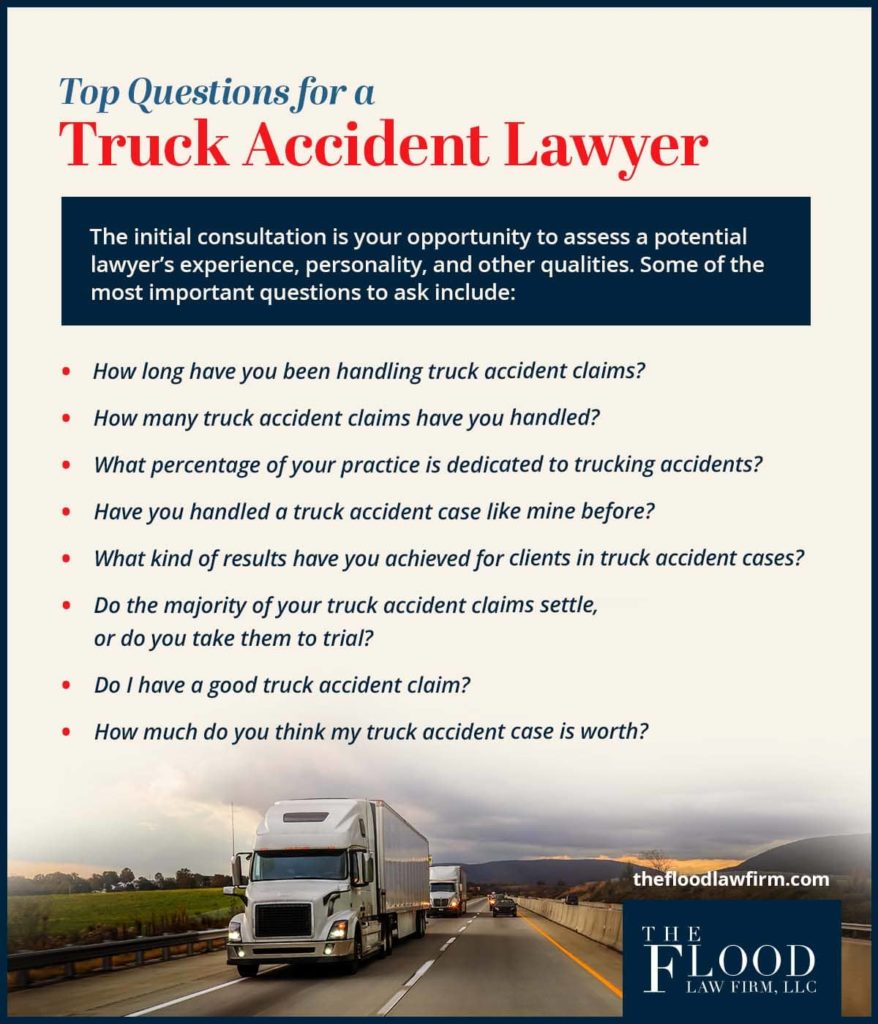
- How long have you been handling truck accident claims?
- How many truck accident claims have you handled?
- What percentage of your practice is dedicated to trucking accidents?
- Have you handled a truck accident case like mine before?
- What kind of results have you achieved for clients in truck accident cases?
- Do the majority of your truck accident claims settle, or do you take them to trial?
- Do I have a good truck accident claim?
- How much do you think my truck accident case is worth?
In addition to questions about experience, qualifications, and the viability of your case, it is also important to know what to expect when working with the firm.
Ask who you will be in contact with the most, whether the attorney you meet will handle your case personally, how quickly the lawyers and staff respond to phone calls and emails, and anything else that gives you a sense of what to expect if you hire the firm to handle your truck accident claim.
Finally, you need to understand how fees are structured. Confirm that your case will be handled on a contingency basis (meaning you pay nothing upfront and only pay fees if a settlement is reached or an award is won at trial). The Flood Law Firm puts the fee agreement in writing upfront so you can rest assured that you won’t pay a dime unless and until we achieve a settlement or judgment on your behalf.
Who Is Responsible for a Truck Accident?
Fault is a complex issue in most truck accident claims. Thorough investigation is essential for identifying all of the liable parties.
An experienced truck accident lawyer can help resolve some of these common questions about legal responsibility in a big rig crash and pursue compensation on your behalf:
Are Truck Drivers Liable for Damages?
The actions of the truck driver are the first thing your attorney will examine in determining who is at fault for the accident. As with any kind of auto accident, a truck driver can be held liable for injuries stemming from negligence behind the wheel.
Some of the most common forms of driver negligence in truck accident claims include:
- Driving too fast
- Reckless and aggressive driving
- Failure to check blind spots before merging or changing lanes
- Talking on the phone, texting, and other types of distracted driving
- Fatigued driving
- Making unsafe turns
- Driving under the influence of alcohol and drugs
In addition to careless behavior behind the wheel, truck drivers may also be held liable for accidents stemming from violations of federal regulations. These include failing to inspect the condition of the rig before driving, failing to inspect and secure the load before the trip, and exceeding the hours of service limits.
Can You Sue a Trucking Company?
Liability for truck accidents is often shared by drivers and their employers. To bring a claim against the trucking company for the negligent actions of the driver, you must be able to prove that (a) the truck driver was an employee of the company and (b) the driver was operating in his/her capacity as an employee at the time of the accident.
Negligence on the part of a carrier that contributed to the accident can also expose the trucking company to liability. Common examples of trucking company negligence that leads to tractor-trailer accidents include:
- Failure to hire qualified drivers
- Inadequate training for truck drivers
- Negligent maintenance of trucks and trailers
- Failure to test drivers for alcohol and drug use
- Implementing unrealistic schedules that force drivers to stay on the road longer than legally allowed
Proving negligence on the part of a trucking company is challenging. The company may conceal or even destroy documents containing incriminating information, as well as take possession of the truck and/or the trailer.
Taking prompt legal action is of the utmost importance to ensure that potential evidence is preserved. A truck accident attorney will act quickly to request that the trucking company produce relevant records and other materials needed to build your case.
Who Else Can Be Sued for a Truck Accident?
Liability for a collision with an 18-wheeler may not be confined to the truck driver and the trucking company. Comprehensive investigation may reveal that one or more additional parties could be at fault.
Additional liable parties in a truck accident claim may include:
- The manufacturer of the truck, trailer, or a component. Product liability claims can be brought against one or more companies involved in the design, manufacturing, and/or sale of a faulty part on the semi-truck.
- A loading or shipping company. The companies that load semi-trucks are responsible for ensuring that the cargo is properly secured and balanced. Loose and imbalanced cargo can cause the truck driver to lose control, or result in items falling off the truck. If investigation reveals that these issues led to the accident, the loading or shipping company could be liable.
- Mechanics and maintenance crews. Liability for accidents caused by negligent maintenance may be shared between the owner of the truck and/or the trailer as well as the party responsible for servicing the vehicle.
- Government entities. The state of the road is an important factor to assess in any truck accident claim. The government agency responsible for maintaining the road may be liable if a dangerous condition (such as potholes, uneven pavement, overly steep grades, etc.) contributed to the truck accident.
- Other motorists. Some truck accidents occur as part of a “chain reaction” when a truck driver tries to avoid colliding with another vehicle. You may have a claim against the other driver if his or her negligence precipitated the accident that led to your injuries.
You must bring claims against all of the liable parties to recover maximum compensation for a truck accident. The Flood Law Firm will perform a comprehensive investigation to determine what caused the accident and who is at fault.
Why Should You Hire a Truck Accident Lawyer?
Trying to handle a truck accident claim on your own is generally a mistake. Your priority after a serious injury or the wrongful death of a family member should be recovering from the trauma, not navigating a complex legal matter.
Commercial carriers, insurance companies, and other opposing parties are highly likely to take advantage of claimants who attempt to represent themselves. If you accept a settlement without consulting a lawyer, you may end up with far less compensation than you deserve. If you say the wrong thing to an insurance adjuster or another representative for the other side, you might forfeit the ability to recover any damages at all.
You should speak to a truck accident lawyer as soon as possible after the crash. Hiring a knowledgeable attorney is the best way to protect your rights and avoid mistakes that could sink your case.
What Evidence Do Lawyers Look For in a Truck Accident?
The evidence required to prevail in a trucking accident claim can be extensive and highly complex in nature. After reviewing your case, a truck accident lawyer will likely start by gathering the following:
- Photographs of the accident scene
- All accident reports, including those prepared by local and state police, the National Transportation Safety Board, etc.
- Witness statements
- Video surveillance of the crash site (if available)
Examination of the vehicles involved in the accident is also essential. In addition to assessing the damage to your vehicle, an attorney can work with the owner of the truck and other parties involved to inspect the big rig for mechanical issues, defects, and more.
A significant amount of important evidence will be in the trucking company’s possession. Your truck accident attorney will issue a letter calling on the carrier to preserve evidence such as:
- Employee records
- The driver’s log book and inspection reports
- Maintenance records for the rig
- Records from cell phones, GPS, and other electronic devices
- Data from the truck’s “black box”
Your attorney will also need your medical records and any paperwork that establishes the damages in your truck accident claim. This may include medical bills, earnings statements that show lost income, out-of-pocket expenses related to the accident, and more.
What Is the Truck Accident Claims Process?
First, it is important to know that you have a limited time to bring a claim after a truck accident. In Connecticut, you only have two years to file a personal injury lawsuit. The same time limit applies in cases where the victim is killed through the negligence of another.
When you contact The Flood Law Firm, we will get started on your claim right away. Our team will collect all of the available evidence, interview witnesses, and hire experts to provide testimony.
During these initial stages, you may be contacted by a representative for the trucking company, an insurance company, and/or another party. It is crucial not to say anything about the accident to anyone but your attorney. Refer the caller to your lawyer if you receive any outside communications, and let him or her take it from there.
The next step is generally settlement negotiations. An insurer might offer to settle (probably for less than your case is worth), or your attorney can make a demand for fair compensation. Once again, it is important to allow your lawyer to do the talking for you to ensure the greatest likelihood of a favorable outcome.
If settlement talks are unproductive, you and your lawyer should discuss filing a truck accident lawsuit. Prior to going to court, your attorney will prepare your case for trial with the goal of obtaining the maximum award on your behalf.
How Long Does It Take to Settle a Semi-Truck Accident Claim?
Because they frequently result in fatalities and serious injuries, truck accident claims can involve hundreds of thousands to millions of dollars. Trucking companies and insurers are businesses, and paying out damages is bad for business. As a result, a fair settlement can be difficult to reach.
You should be prepared for the liable parties and the insurance companies to drag their feet in settlement negotiations. “Low-ball” offers and even a refusal to settle are not uncommon.
Depending on the circumstances of your case (including the severity of your injuries, the value of damages, issues of complex liability, etc.), it can take several months to more than a year to reach a truck accident settlement.
Waiting for your case to settle can be extremely trying. It is important to hire a truck accident lawyer who can advocate for your interests, communicate with you regularly on the status of negotiations, and discuss whether a settlement offer is fair.

Get a Truck Accident Attorney
If you or a loved one has been injured in an accident involving a tractor-trailer or semi-truck, you should speak with our Connecticut truck accident lawyers who handle these types of cases.
Not only will your attorney understand the hardships your family now faces, they understand the laws that apply to truck drivers and have the resources to conduct a thorough investigation.
Contact The Flood Law Firm today to speak with a Connecticut personal injury lawyer about your rights and your options.
We want to hear what happened, and we want to help.
Client Testimonial
"Above and beyond customer service. The entire staff is very professional and committed to excellence. I usually do not write reviews, but my experience working with Flood Law Firm exceeded my expectations." - Evelyn B. ⭐⭐⭐⭐⭐
Read more of our Google reviews.
Connecticut Office
190 Washington Street
Middletown, CT 06457
P: (860) 346-2695